- Entry date 16.03.2026 Condition Monitoring – Special Offer for Wind Turbines GfM’s Peakanalyzer condition monitoring system has proven itself over many years in the monitoring...
-
Entry date 10.12.2025
Monitoring service for third-party systems using continuous online spectral analysis

-
Entry date 24.07.2025
Condition monitoring at HUSUM WIND 2025
-
Entry date 16.07.2025
Condition monitoring saves system operators a lot of money
-
Entry date 27.01.2025
Drum coupling monitoring - Automatic condition monitoring on cranes

-
Maintenance München
08.10.2026
-
34th Wind Energy Days in Linstow
10.11.2026 - 12.11.2026
Foundations at Wind Turbines
In recent years, was reported increasingly about problems of foundations of wind turbines. The concrete assessment of each makes investigations on the individual turbines necessary. In addition to the extensive direct assessment of the foundation itself by specialists can be uses for hardening of a concrete initial suspicion indirect measurement methods in question, which describe not the foundation itself, but the movement of the foundation installation part.
Movements of foundation installation part are the result of loads. Loads can be either provoked, for example by an emergency stop of the system, or you can use loads from the normal system operation, which is much gentler on the wind turbine.
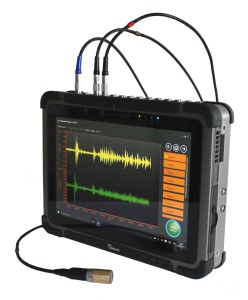
To analyze the movements of the foundation installation part as a result of normal operational loads, the Baseanalyzer at the wind turbine is permanently installed and measures online around the clock all operating situations. As sensors displacement sensors and strain sensors are used.
The Baseanalyzer is available as an independent system or as part of the Peakanalyzer.

Installation and Configuration
The displacement and strain sensors are installed in the area of the foundation installation part. This is usually done in a few hours. Often it is sufficient to measure in the prevailing wind direction and transversely to this.
Monitored is the movement of the tower. An alarm threshold can be entered freely and naturally changed at any time. The combination of displacement and strain sensors allows for the distinction between admissible elastic elongation and critical tower movement.
As a strain sensor, a strain gauge measuring point is applied.